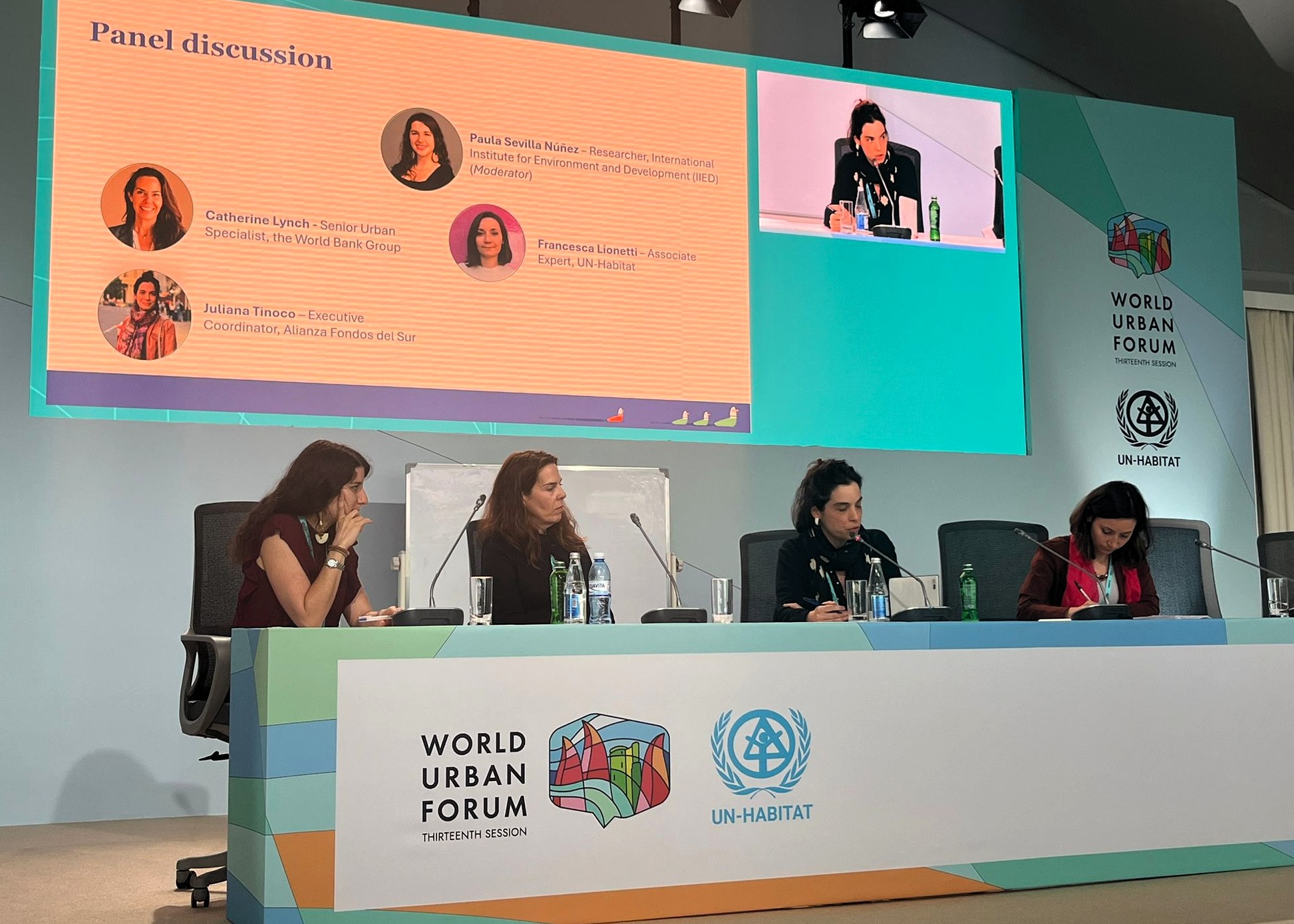
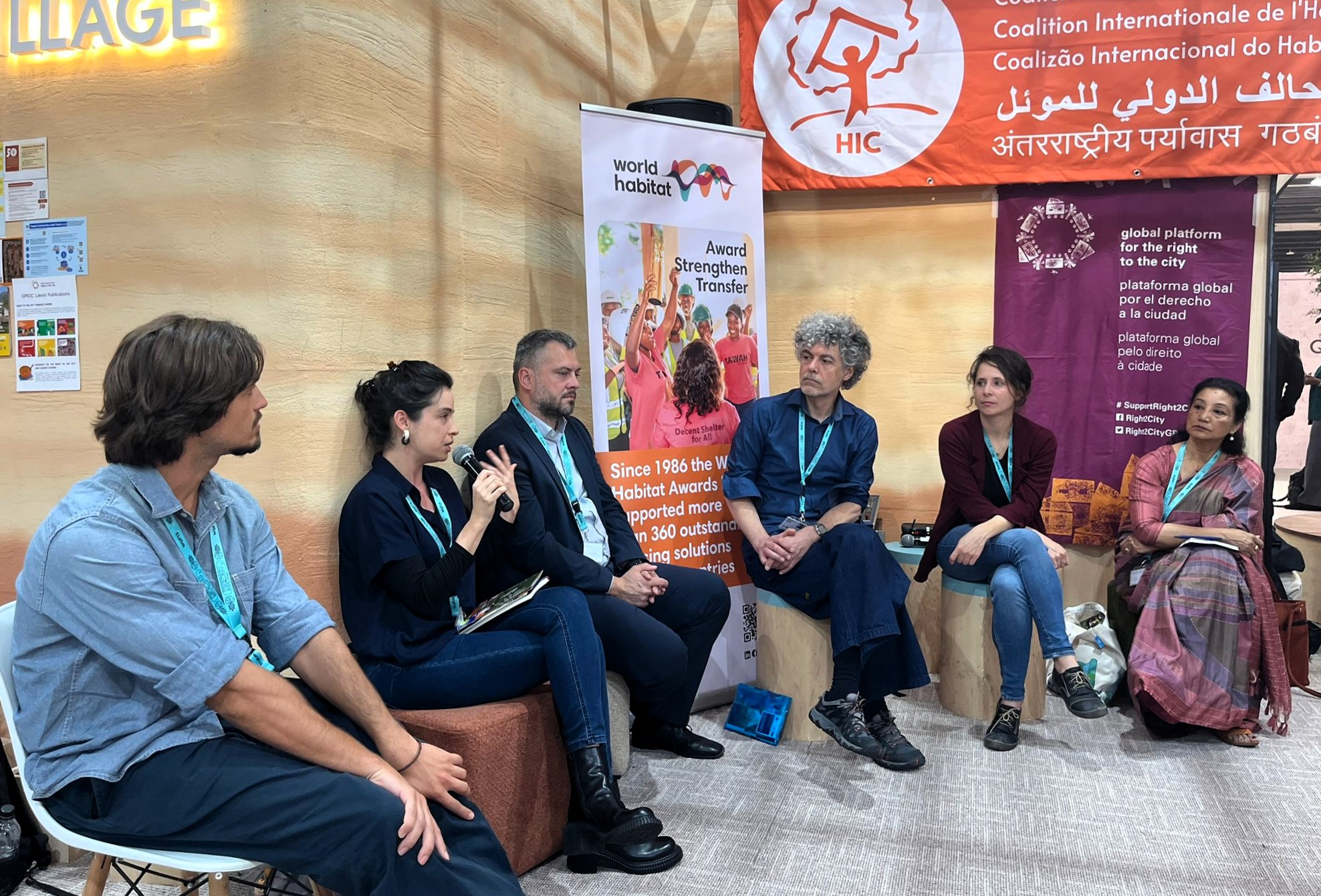
Reflections by Juliana Tinoco, Executive Coordinator of Alianza, following her participation in the 13th World Urban Forum (WUF13).
I attended the 13th World Urban Forum (WUF13) in Baku at the invitation of the International Institute for Environment and Development (IIED), where I joined must-needed discussions about the future of our cities.
The Forum marked the launch of the World Cities Report 2026 by UN-Habitat, which presents a staggering figure: nearly 3 billion people worldwide lack access to adequate housing. At the same time, the climate crisis is projected to have an even more devastating impact — 167 million homes could be destroyed by climate-related disasters by 2040. As always, the most vulnerable populations will bear the heaviest burden.
In the face of what the UN itself describes as an “emergency,” one major myth continues to paralyze debates around financing socio-environmental justice in urban contexts: the belief that residents of informal settlements, small-scale housing producers, and grassroots communities are “high-risk” or “unbankable” actors. One thing became clear throughout WUF:
We continue to treat housing as a short-term financial asset, allowing speculative capital to shape urban development, rather than recognizing housing as essential social and environmental infrastructure for our cities.
The response requires moving away from the notion of housing as a financial commodity driven by short-term profit. We need a financial architecture that is redistributive, solidarity-based, and committed to the social and environmental function of the territories.
And these pathways already exist.
Community-led and solidarity-based finance: cities are already innovating
The report Financing Housing Justice — launched by the Hub for Housing Justice in collaboration with the IIED and several civil society networks — presents real and scalable pathways through community-led finance.
Among the examples highlighted in the report are community financing models such as revolving funds fueled by catalytic capital to support housing cooperatives, community savings mobilization to secure microcredit through solidarity groups, and tenure models that decommodify property by linking housing costs to local income levels.
What is already working: community-led examples
In Central and Southeast Europe, the cooperative network MOBA Housing SCE created an accelerator based on a cooperative revolving property fund. Through catalytic capital, they enable permanently affordable housing outside speculative market dynamics, where land remains collectively owned and protected from market pressures.
In Zimbabwe, the Gungano Urban Poor Fund demonstrates the power of solidarity economies. Through savings groups organized by residents of informal settlements, communities historically excluded from the banking system are able to access credit and improve their housing conditions incrementally and resiliently.
In Brazil, the Favela Community Land Trust model, implemented by Catalytic Communities, separates land ownership from home ownership, protecting popular territories from real estate speculation and strengthening security of tenure.
The turning point: who decides where the money goes
What connects the success of these experiences is the power structure: when communities control resources and decision-making, outcomes become more sustainable, more just, and more resilient.
This is where the conversation on finance must change.
The work of the socio-environmental justice funds within Alianza Socioambiental Fondos del Sur reinforces this message. Our funds demonstrate in practice that transferring decision-making power and resources directly to grassroots organizations is not a risk — it is an opportunity.
Our funds operate through a logic fundamentally different from traditional financial architecture:
participatory governance with territorial leadership;
flexible, long-term financing (core funding);
microgrants adapted to local realities;
continuous technical support and administrative simplification;
rapid response mechanisms in contexts of climate crisis and displacement.
It represents a shift in paradigm: from control to trust; from projects to territories; from short-term cycles to permanence.
What WUF13 leaves me with
There will be no just urban transition without real redistribution of power and resources.
The cities of the future are already being built today. Many of them are not found in large-scale urban master plans, but in the hands of communities that, for decades, have been creating solutions where systems have failed to reach.
Perhaps the greatest challenge before us is not to innovate more, but to learn to trust more.